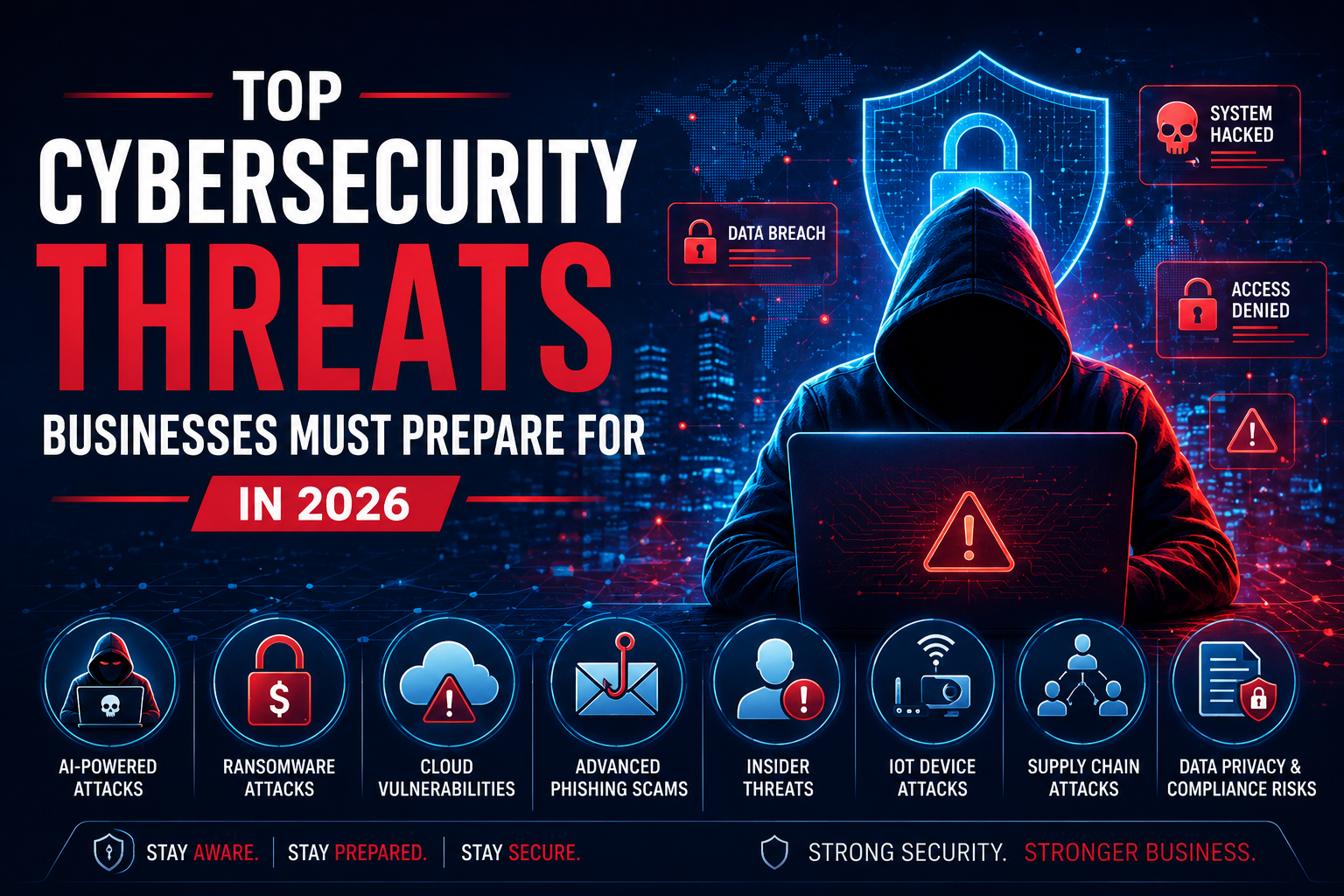
Top Cybersecurity Threats Businesses Must Prepare for in 2026
Cybersecurity is no longer just an IT department concern. In 2026, it has become a core business survival issue.
As businesses continue shifting toward digital operations, cloud infrastructure, AI-powered systems, and remote work environments, cybercriminals are becoming more advanced than ever before. Modern attacks are faster, smarter, and more damaging.
A single cyberattack can destroy customer trust, leak sensitive data, interrupt operations, and cause massive financial losses.
From ransomware and AI-generated phishing scams to cloud vulnerabilities and insider threats, organizations now face a rapidly evolving cybersecurity landscape.
In this blog, we’ll explore the top cybersecurity threats businesses must prepare for in 2026 and the strategies companies should implement to stay protected.
Why Cybersecurity Matters More Than Ever in 2026
The global digital ecosystem is expanding rapidly. Businesses are handling more customer data, financial information, and online transactions than ever before.
At the same time:
Remote work is increasing
Cloud adoption is accelerating
AI tools are becoming mainstream
IoT devices are expanding rapidly
Cybercriminals are using automation and AI
This creates more entry points for hackers.
Cybersecurity is no longer optional. It is a business-critical investment that directly affects:
Brand reputation
Customer trust
Legal compliance
Financial stability
Operational continuity
Companies that fail to prioritize cybersecurity are exposing themselves to enormous risks.
1. AI-Powered Cyberattacks
Artificial Intelligence is helping businesses improve productivity, but hackers are also using AI to launch more sophisticated attacks.
AI-powered cyberattacks can:
Automate hacking attempts
Generate realistic phishing emails
Crack passwords faster
Mimic human behavior
Identify system vulnerabilities automatically
Cybercriminals are now using generative AI tools to create highly convincing fake messages, deepfake audio, and scam videos.
Why It’s Dangerous:
Traditional security systems struggle to detect AI-generated threats because these attacks constantly evolve and adapt.
Protection Strategies:
Use AI-powered cybersecurity systems
Implement multi-factor authentication (MFA)
Train employees regularly
Monitor suspicious behavior in real time
Businesses that rely only on traditional antivirus solutions are already behind.
2. Ransomware Attacks are Becoming More Aggressive
Ransomware remains one of the biggest cybersecurity threats in 2026.
In a ransomware attack, hackers encrypt company data and demand payment to restore access. Many attackers now also steal sensitive data before encryption and threaten to leak it publicly.
Modern ransomware groups specifically target:
Financial institutions
Healthcare organizations
Government agencies
Manufacturing companies
Small businesses with weak security
Common Entry Points:
Phishing emails
Weak passwords
Unpatched software
Remote desktop vulnerabilities
Prevention Tips:
Maintain secure backups
Keep software updated
Restrict user access
Use endpoint protection systems
Conduct regular security audits
Paying the ransom does not guarantee data recovery. Prevention is far more effective than recovery.
3. Cloud Security Vulnerabilities
Cloud computing adoption is growing rapidly, but many businesses still fail to secure their cloud environments properly.
Misconfigured cloud storage, weak access controls, and poor monitoring are creating major security gaps.
Common Cloud Security Risks:
Unauthorized access
Data leaks
Weak API security
Insider threats
Misconfigured servers
Many businesses mistakenly assume cloud providers handle all security responsibilities. In reality, security is a shared responsibility.
Best Practices:
Use zero-trust security models
Encrypt sensitive data
Enable access controls
Monitor cloud activity continuously
Conduct cloud security assessments
As businesses move more operations to the cloud, securing cloud infrastructure becomes essential.
4. Phishing Attacks are More Convincing Than Ever
Phishing attacks are evolving rapidly in 2026.
Hackers now use AI-generated content, personalized targeting, and social engineering to trick employees into:
Sharing passwords
Downloading malware
Transferring funds
Revealing sensitive information
Modern phishing emails look extremely realistic and often imitate trusted brands or executives.
Emerging Threats:
AI-generated phishing emails
Deepfake voice scams
Fake video meetings
QR code phishing
How Businesses Can Protect Themselves:
Conduct employee awareness training
Use email security filters
Verify financial requests manually
Enable multi-factor authentication
Human error remains one of the biggest cybersecurity weaknesses.
5. Insider Threats are Increasing
Not all cyber threats come from external hackers.
Insider threats involve employees, contractors, or partners who intentionally or accidentally expose company data.
Insider Threat Examples:
Data theft
Sharing confidential files
Weak password practices
Unauthorized access
Negligent behavior
Remote work environments have made insider risk management more difficult.
Prevention Strategies:
Implement role-based access controls
Monitor user behavior
Restrict sensitive data access
Conduct cybersecurity training
Use data loss prevention (DLP) tools
Even trusted employees can become security risks without proper controls.
6. IoT Device Attacks
Internet of Things (IoT) devices are growing rapidly across industries.
Connected devices include:
Smart cameras
Industrial sensors
Smart offices
Medical devices
Manufacturing equipment
Unfortunately, many IoT devices have weak security protections.
Hackers often target these devices because they are easier to exploit than traditional systems.
IoT Security Risks:
Weak passwords
Unpatched firmware
Insecure network connections
Lack of encryption
Security Recommendations:
Change default passwords
Update device firmware regularly
Separate IoT devices from critical systems
Monitor network activity
As IoT adoption increases, device security becomes increasingly important.
7. Supply Chain Cyberattacks
Cybercriminals are increasingly targeting third-party vendors and software providers to gain access to larger organizations.
A single compromised supplier can impact thousands of businesses.
Why Supply Chain Attacks are Dangerous:
Difficult to detect
Can bypass traditional defenses
Spread rapidly across networks
Impact multiple organizations simultaneously
Protection Methods:
Vet vendors carefully
Conduct third-party security assessments
Limit external access permissions
Monitor software updates and integrations
Businesses must now evaluate the cybersecurity posture of all partners and vendors.
8. Data Privacy and Compliance Risks
Governments worldwide are introducing stricter data protection regulations.
Businesses that fail to secure customer data may face:
Heavy financial penalties
Legal action
Reputation damage
Loss of customer trust
Important Compliance Areas:
Data encryption
User consent management
Access controls
Incident reporting
Secure data storage
Companies handling customer information must prioritize data privacy alongside cybersecurity.
How Businesses Can Strengthen Cybersecurity in 2026
Cybersecurity is not just about installing antivirus software anymore.
Modern protection requires a multi-layered strategy.
Essential Cybersecurity Measures:
Implement zero-trust architecture
Use AI-powered threat detection
Conduct employee security training
Regularly update systems
Perform vulnerability testing
Maintain secure backups
Monitor networks continuously
Enforce strong password policies
Organizations should treat cybersecurity as an ongoing process rather than a one-time setup.
The Future of Cybersecurity
Cybersecurity in 2026 is becoming increasingly AI-driven.
Future security systems will focus on:
Automated threat detection
Predictive security analytics
Real-time response systems
Behavioral monitoring
Self-healing infrastructure
At the same time, attackers will continue using advanced technologies to exploit vulnerabilities.
The cybersecurity battle will become a continuous race between intelligent defense systems and intelligent attackers.
Businesses that fail to evolve will struggle to survive in the digital economy.
Final Thoughts
Cyber threats are becoming more sophisticated, more frequent, and more expensive.
In 2026, businesses can no longer afford weak cybersecurity practices.
Organizations must prepare for:
AI-powered attacks
Ransomware
Cloud vulnerabilities
Phishing scams
Insider threats
IoT risks
Supply chain breaches
The companies that invest in proactive cybersecurity strategies today will be far more resilient tomorrow.
Cybersecurity is no longer just about protecting systems — it is about protecting business continuity, customer trust, and long-term growth.
Conclusion
The digital world is evolving rapidly, and cybersecurity threats are evolving even faster.
Businesses that want to remain secure in 2026 must adopt modern, intelligent, and proactive security strategies. Waiting until after an attack happens is no longer a viable approach.
Strong cybersecurity is now a competitive advantage.
Companies that prioritize security will gain customer trust, improve operational stability, and reduce long-term risks in an increasingly connected world.
External Source:
https://www.cisco.com/site/us/en/learn/topics/security/what-is-cybersecurity.html