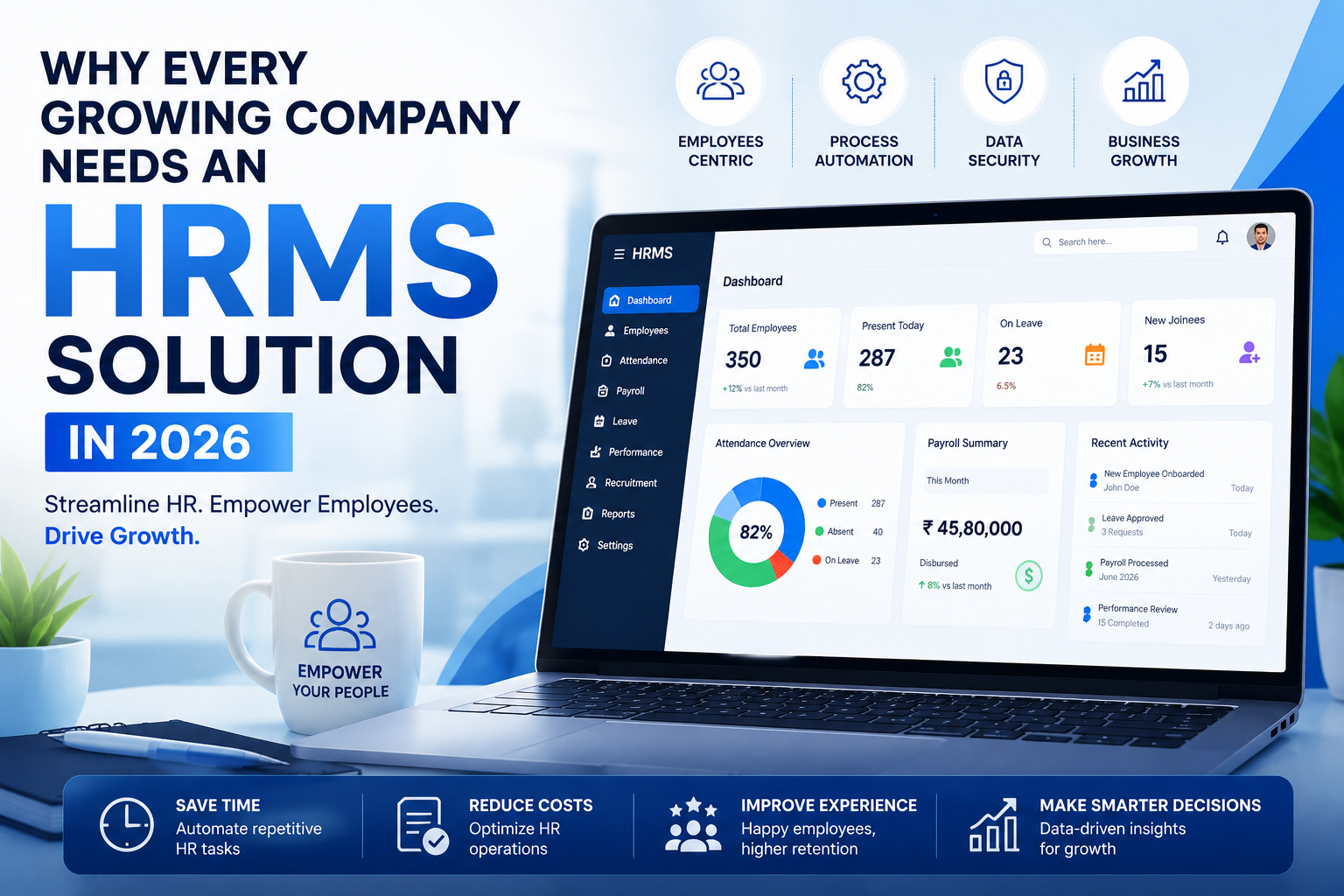
Why Every Growing Company Needs an HRMS Solution in 2026
Managing employees is becoming more complex than ever.
As businesses grow, handling attendance, payroll, recruitment, employee performance, compliance, and HR operations manually becomes inefficient, time-consuming, and expensive.
In 2026, companies are rapidly shifting toward digital HR management systems to improve efficiency, reduce operational costs, and create better employee experiences.
This is where an HRMS Solution becomes essential.
An HRMS (Human Resource Management System) helps businesses automate and streamline HR processes through a centralized digital platform.
From payroll automation to employee tracking and performance management, HRMS software is transforming how modern organizations manage their workforce.
In this blog, we’ll explore what an HRMS solution is, why growing companies need it, and how it helps businesses scale efficiently in 2026.
What is an HRMS Solution?
An HRMS (Human Resource Management System) is a software platform designed to manage and automate core HR functions.
It helps organizations handle:
Employee records
Attendance tracking
Payroll management
Recruitment
Leave management
Performance monitoring
Compliance management
Employee onboarding
Instead of managing multiple spreadsheets and manual processes, businesses can control everything from a single centralized system.
Modern HRMS platforms are cloud-based, scalable, and accessible from anywhere.
Why Growing Companies Need an HRMS Solution
As companies expand, HR operations become increasingly difficult to manage manually.
Without a proper HR system, businesses often face:
Payroll errors
Attendance issues
Employee data mismanagement
Compliance risks
Productivity loss
Slow recruitment processes
An HRMS helps eliminate these challenges through automation and centralized management.
1. HR Process Automation Saves Time
Manual HR tasks consume a huge amount of time.
HR teams often spend hours handling:
Attendance records
Salary calculations
Leave approvals
Employee updates
Documentation
An HRMS automates these repetitive processes.
Benefits:
Faster HR operations
Reduced manual work
Improved accuracy
Increased productivity
Automation allows HR teams to focus on strategic growth instead of administrative tasks.
2. Payroll Management Becomes Easier
Payroll errors can damage employee trust and create compliance issues.
An HRMS simplifies payroll management through:
Automated salary calculations
Tax deductions
Bonus processing
Payslip generation
Compliance reporting
Advantages:
Accurate payroll
Reduced calculation errors
Faster salary processing
Better compliance management
Growing companies need reliable payroll systems to maintain operational efficiency.
3. Better Employee Data Management
Managing employee records manually becomes difficult as teams grow.
An HRMS stores:
Personal information
Attendance history
Performance records
Salary details
Documents
Compliance data
Everything becomes organized and easily accessible.
Key Benefits:
Centralized employee database
Faster information access
Improved security
Reduced paperwork
Digital employee management improves operational control significantly.
4. Attendance and Leave Tracking Improves Efficiency
Tracking attendance manually creates confusion and inaccuracies.
Modern HRMS platforms provide:
Biometric integrations
GPS attendance
Mobile check-ins
Automated leave management
Shift scheduling
Business Benefits:
Reduced attendance fraud
Accurate work tracking
Better workforce management
Improved transparency
This becomes especially important for remote and hybrid work environments.
5. Improved Employee Experience
Employees today expect digital convenience.
An HRMS allows employees to:
Apply for leave online
Access payslips instantly
Update personal details
Track attendance
Submit requests digitally
Self-service portals improve employee satisfaction and reduce dependency on HR teams.
Better Employee Experience Leads To:
Higher engagement
Improved productivity
Better retention rates
Employee experience is becoming a major competitive advantage in 2026.
6. Faster Recruitment and Onboarding
Hiring processes become slower and more chaotic without proper systems.
An HRMS helps automate:
Job postings
Candidate tracking
Interview scheduling
Offer management
Employee onboarding
Recruitment Benefits:
Faster hiring
Better candidate management
Reduced paperwork
Improved onboarding experiences
Growing businesses need efficient hiring systems to scale quickly.
7. Performance Management and Analytics
Modern HRMS platforms include performance tracking tools that help companies monitor employee productivity and growth.
Features include:
KPI tracking
Goal management
Appraisal systems
Performance reports
Employee feedback systems
Benefits:
Better employee development
Data-driven decisions
Increased productivity
Improved workforce planning
Analytics help management make smarter HR decisions.
8. Compliance and Data Security
HR departments handle sensitive employee information.
An HRMS improves:
Data protection
Access control
Compliance tracking
Audit management
Document security
This helps companies stay compliant with labor laws and regulatory requirements.
Security Features:
Role-based access
Data encryption
Backup systems
Secure cloud storage
Security becomes critical as businesses digitize HR operations.
9. Supports Remote and Hybrid Work
Remote work is now a permanent part of modern business operations.
Cloud-based HRMS platforms allow businesses to manage employees from anywhere.
Remote Work Features:
Online attendance
Remote approvals
Virtual onboarding
Cloud access
Employee collaboration tools
Companies without digital HR systems struggle to manage distributed teams efficiently.
10. Scalability for Business Growth
As organizations grow, HR complexity increases rapidly.
An HRMS allows businesses to scale without massively increasing HR workload.
Scalable Benefits:
Manage larger teams
Support multiple branches
Handle growing employee data
Automate expanding workflows
This makes HRMS solutions essential for startups, SMEs, and enterprise businesses alike.
Key Features Every Modern HRMS Should Have
A modern HRMS platform should include:
Essential Features:
Payroll automation
Attendance management
Employee self-service portal
Recruitment management
Leave tracking
Performance monitoring
Compliance management
Mobile accessibility
Analytics dashboard
Cloud infrastructure
The right HRMS should improve both operational efficiency and employee satisfaction.
Challenges of Managing HR Without an HRMS
Businesses still relying on manual HR processes often face:
Payroll delays
Human errors
Data loss
Compliance risks
Low productivity
Employee dissatisfaction
As businesses grow, these problems become more expensive and difficult to manage.
Future of HRMS in 2026 and Beyond
HR technology is evolving rapidly.
Future HRMS systems will increasingly use:
Artificial Intelligence
Predictive analytics
AI recruitment tools
Employee sentiment analysis
Automated workforce planning
AI-powered HRMS platforms will help businesses make smarter workforce decisions while improving employee experiences.
Companies investing in modern HR systems today will have a major competitive advantage tomorrow.
Final Thoughts
An HRMS solution is no longer optional for growing companies.
In 2026, businesses need intelligent HR systems to:
Automate operations
Improve efficiency
Reduce costs
Enhance employee experiences
Support scalable growth
Manual HR management simply cannot keep up with the demands of modern business environments.
Organizations that adopt digital HR solutions will operate faster, smarter, and more efficiently than competitors relying on outdated systems.
Conclusion
As businesses continue growing and work environments become more digital, managing human resources efficiently becomes critical.
An HRMS solution helps companies simplify operations, improve workforce management, reduce administrative workload, and support long-term growth.
Modern businesses need modern HR systems.
Companies that invest in scalable HRMS platforms today will build stronger, more productive, and future-ready organizations tomorrow.
Best HRMS:
External Source:
https://www.oracle.com/human-capital-management/hrms/